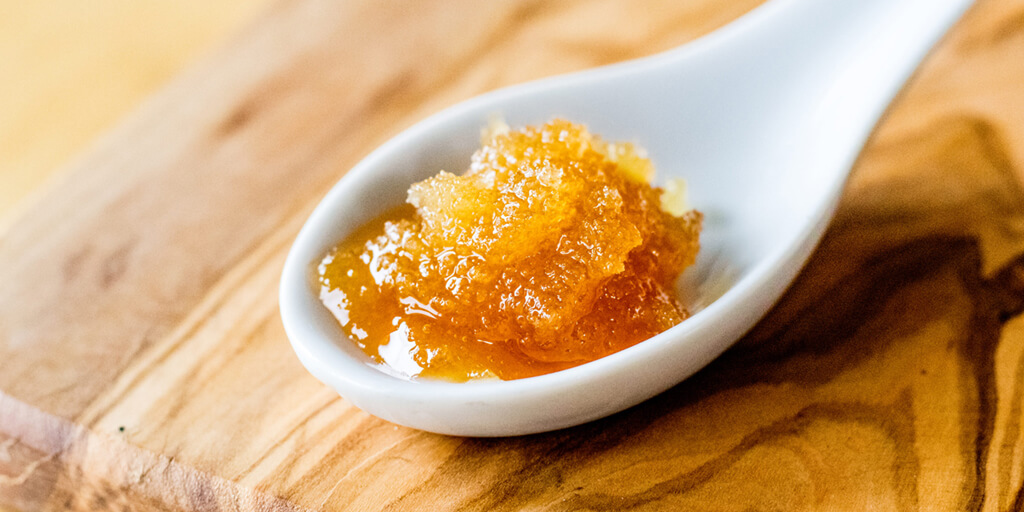
Honey as a supersaturated solution (contains more sugar than it can hold), is unstable, and tends to precipitate excess sugar. At first small glucose crystals form on the walls and bottom of the container, later new ones are added until glucose agglomerates appear.
Crystallization is a natural property of honey and is not related to its nutritional and biological value. Both the pure and the adulterated product can crystallize or remain in a fluid state.
There is a direct relationship between crystallization and the percentage of glucose and moisture present in honey. ‘So the higher the ratio of glucose to moisture, the faster the crystallization. The temperature that favors crystallization is from 8 to 14 degrees Celsius. ‘The farther we go from this temperature (up or down) the slower it is. It is recommended to store honey in places with high temperatures, but without the sun seeing it!
In any case, honey can be consumed even crystallized (candied) without any risk to the consumer. The only point to pay attention to is when the honey partially crystallizes, as the part that remains liquid is in danger of becoming sour. In this case we must restore it to its original state.
Be careful when eating honey, do not put the spoon in the jar a second time, after contact with your mouth. The moisture of the saliva together with the enzymes lead to the gradual decomposition of the honey and its sourness. Only clean and dry spoon.
Crystallization rate of Greek pure honey categories.
Pine honey -> After 24 months Fir -> It does not crystallize Kastanias -> 12 to 18 months Thyme -> 8 to 18 months Orange -> 1 to 3 months Cotton -> 1 to 2 months Heather -> 2 to 3 months Sunflower -> 1 to 2 months * The crystallization time is valid for pure honeys that have not undergone any heat or other treatment and are kept at room temperature.
How do I restore the honey to its original state? What is the best technique?
Method A: Microwave Oven After removing the lid, place the jar in the microwave at maximum power and for exactly 1 minute. Remove the jar and stir very well with a dry spoon so that the remaining crystals are completely liquefied with the temperature developed. Finally close the jar with the lid and put it immediately under cold tap water for 30-40 seconds. Wipe the jar and store it. * Source: AUTΗ Beekeeping Laboratory
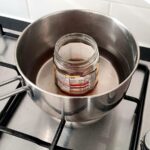
Method B: Water bath We liquefy the honey by heating, which when done correctly does not affect the quality of the product. Proper heating is ensured with the lowest possible temperature, the shortest time and the use of double-walled containers (Bain Marie) so that the honey does not come into contact with the hob. High temperature for a long time destroys the enzymes, the antibacterial action of honey, breaks down sugars and affects the substances that contribute to its taste and aroma. Usually a temperature of less than 45 degrees Celsius for a long time (24-48 hours) does not affect the characteristics of honey.